Composing…
/Arulmigu Meenakshi Amman Temple
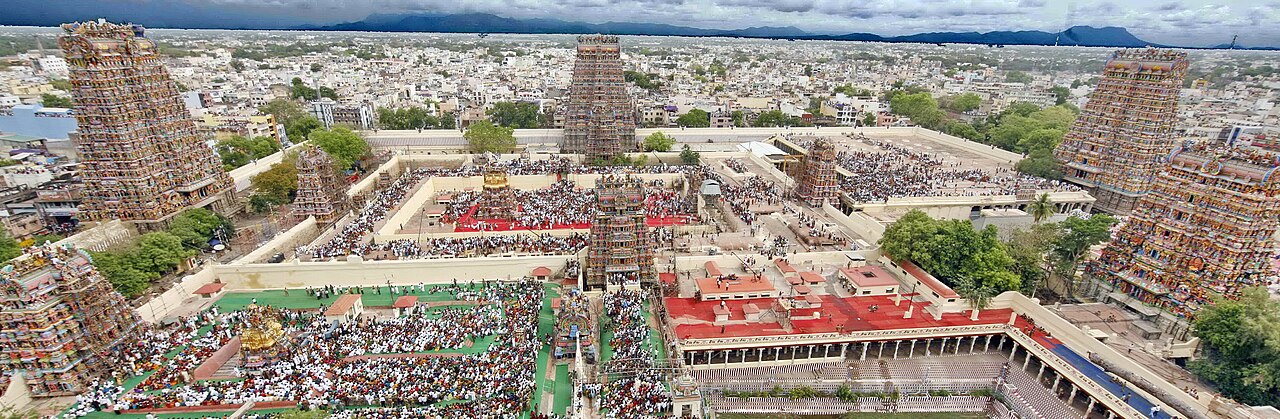
Major Temple
Arulmigu Meenakshi Amman Temple
अरुलमिगु मीनाक्षी अम्मन मंदिर
Location
Madurai, Tamil Nadu
Darshan
05:00 – 22:00
Deity
🪔Goddess Meenakshi (Parvati)
Entry
Free entry
The temple is open 5:00 AM to 12:30 PM in the morning and 4:00 PM to 10:00 PM in the evening, closing for midday rest. Both the Meenakshi Amman shrine and the Sundareswarar shrine have their own darshan queues. Entry is free for all — Hindus and non-Hindus are both welcomed, unlike many other Tamil Nadu temples. A camera fee (approximately ₹50) is charged for bringing a camera inside the temple. Mobile phones are generally permitted for photography in the outer areas. On Fridays, a special evening procession (Alankara Puja) takes place in the Aazhimoolaiamman Mandapam. Darshan queues on ordinary days: 30–60 minutes. On Meenakshi Thirukalyanam festival days, wait times can exceed 4–6 hours. Dress code: modest traditional Indian attire preferred; men removing shirt optional inside sanctum; women in saree or salwar kameez preferred.
Arulmigu Meenakshi Amman Temple is among the most iconic and revered temples in India, a living monument to Dravidian architecture and Tamil Shaivism that has been active for over 2,000 years. The temple is simultaneously: - A Shakti Peeth (sacred site of Sati's body part) - A Rajata Sabha (one of five cosmic Shiva dance stages) - The spiritual and cultural heart of Madurai — the oldest continuously inhabited city in south India (approximately 2,500+ years old), mentioned in ancient Sangam literature The presiding goddess Meenakshi (literally 'fish-eyed one' — a term of beauty in Tamil poetic tradition) is a manifestation of Goddess Parvati. She is depicted as a warrior-queen (Devi holding lotus flowers and a parrot) and is considered the true ruler of Madurai — the city is laid out in a mandala around her temple. Lord Sundareswarar (Shiva as 'the Beautiful One') is her consort and is considered secondary to her in this temple — a remarkable inversion of the usual patriarchal temple hierarchy. The annual Meenakshi Thirukalyanam festival (celestial wedding) draws over 1 million pilgrims to Madurai in April, making it one of the largest annual religious gatherings in South India.
History
The origins of the Meenakshi shrine predate written history. Ancient Sangam Tamil literature (approximately 300 BCE – 200 CE) refers to the goddess Meenakshi and the sacred tank at Madurai, suggesting the site's antiquity is at least 2,300 years. According to temple tradition and the Sthala Purana (temple history text), Lord Indra (king of the gods) discovered a Svayambhu linga (self-manifested Shiva linga) at this spot while wandering with an elephant. He built the first shrine around the linga. The city of Madurai grew around this shrine. **Historical expansion timeline:** - **Pandya dynasty era (3rd century BCE–13th century CE)**: The early Pandya kings, whose capital was Madurai, were major patrons of the temple. The presiding deity Meenakshi (a warrior princess born to King Malayadhwaja Pandya per mythology) was integrated into the Pandya royal identity. - **Madurai Sultanate (1335–1378 CE)**: The Delhi Sultanate's invasion of Madurai under Malik Kafur (1310 CE) and subsequent Madurai Sultanate period led to significant damage to the temple. Many treasures were looted and the structure was damaged. The shrine was restored when the Vijayanagara Empire extended its control over Madurai. - **Vijayanagara Empire (14th–16th century CE)**: Major restoration and initial gopuram construction under Vijayanagara patronage. - **Nayak dynasty (1529–1736 CE)**: The most significant period of construction. The Nayak kings — particularly **Vishwanatha Nayak (r.1529–1563 CE)** and **Thirumalai Nayak (r.1623–1659 CE)** — undertook massive expansion of the temple: building 14 gopurams, the Hall of 1,000 Pillars, the Rani Mangammal mandapam, and extending the outer parikrama walls to create the current rectangular complex. The Thirukalyanam festival was institutionalised during this period. The Nayak courtly tradition of literature, music, and Bharatanatyam dance developed in close connection with the temple. - **Rani Mangammal (1689–1707 CE)**: The queen regent of the Nayak dynasty made significant contributions to the temple structure and governance. - **British Colonial period**: The temple was managed by successive British and later Indian government bodies; the HR&CE (Hindu Religious and Charitable Endowments) Department of Tamil Nadu has administered the temple since Indian independence. - **Present day**: The temple is administered by the Tamil Nadu HR&CE Department and managed by the Arulmigu Meenakshi Sundareswarar Temple Trust.
Mythology
The Meenakshi Sthala Purana narrates the following central mythology: King Malayadhwaja Pandya of Madurai performed great penances (tapas) desiring a son to continue his lineage. Instead, the fire of the yajna (sacrificial fire) produced a **girl child with three breasts** — extraordinary and divine. A divine voice assured the king: "Raise her as you would a prince. Her third breast will disappear when she meets her destined consort." Meenakshi was raised as a warrior princess, educated in all royal arts, and eventually became queen of Madurai. She led armies on a conquest of the world, defeating even the gods — Indra, Brahma, Vishnu, and their armies — one by one. Finally, at Mount Kailash, she encountered Lord Shiva. At that moment, her third breast vanished — fulfilling the divine prophecy — and she realised Lord Shiva was her destined husband. Lord Shiva, taking the form of **Sundareswarar** (The Beautiful One), came to Madurai and married Meenakshi in an elaborate celestial wedding. The gods themselves attended: Lord Vishnu gave away the bride. This divine wedding — called **Meenakshi Thirukalyanam** — is re-enacted annually at the temple in a festival that draws over 1 million pilgrims. The couple settled at Madurai, where Meenakshi and Sundareswarar reign as the divine rulers of the city. The city's very layout — arranged in concentric square rings around the temple — mirrors this cosmological sovereignty. The goddess Meenakshi is depicted as emerald-green (symbolic of vitality and nature), with fish-shaped eyes (Meenakshi = fish-eyed; fish was the symbol of the Pandya dynasty and represents perfection in Tamil aesthetic tradition), holding a lotus flower in one hand and a parrot (symbolising the divine soul) in the other.